Top 10 Credit Card Companies in India: Market Capital, Application Criteria, and Card Breakdown
India’s payment landscape is currently experiencing an unprecedented structural transformation. Primarily, this shift is driven by rapid digital adoption, evolving consumer lifestyles, and seamless co-branded rewards programs. Consequently, navigating this booming financial market requires a clear understanding of the top 10 credit card companies in India. Together, these industry leaders hold the dominant market share while simultaneously offering extensive credit capacity. Furthermore, as millions of consumers continuously upgrade from basic debit cards to sophisticated credit-backed financing systems, evaluating card issuers based on their market capital, financial strength, and consumer privileges has become essential for sound money management.
Ultimately, whether you are looking for lifetime free credit options, high-yield cashback benefits, zero foreign exchange markup, or even RuPay cards linked directly to UPI networks, choosing the right bank among the top 10 credit card companies in India depends heavily on your credit score, household income, and, above all, your specific spending patterns.
Market Share Dynamics and Purchasing Capability
The purchasing power of Indian credit card holders has reached historic highs, with total monthly spending surpassing ₹2.0 trillion. Consequently, the active credit card base across the country has crossed 122 million cards, driven primarily by seamless merchant integrations, e-commerce sale events, and the introduction of UPI-linked RuPay credit cards.
Key Financial Metrics in India’s Credit Market:
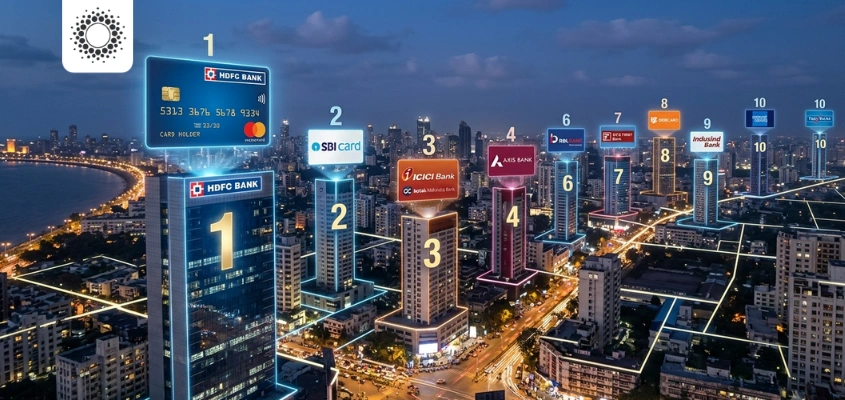
- Market Dominance: The top 4 banking issuers—HDFC Bank, SBI Card, ICICI Bank, and Axis Bank—control over 70% of the entire Indian credit card market share.
- Rising Spending Power: Premium card variants now average higher monthly spends per active cardholder, pushed by travel and lifestyle expenditure.
- UPI Credit Integration: RuPay-enabled credit cards now account for a major share of new issuances, allowing consumers to make credit-backed UPI payments at everyday merchant QR codes.
Credit Card Application Eligibility Criteria
Before initiating an online application with any of the top 10 credit card companies in India, verifying that you meet the bank’s core eligibility parameters ensures a high probability of instant approval and prevents hard credit enquiry rejections.
1. Age Requirement
Primary applicant age must be between 21 to 65 years for salaried individuals and up to 70 years for self-employed professionals.
2. Income Criteria
Minimum net monthly salary of ₹15,000+ for entry-level cards; ₹50,000+ for mid-tier premium variants; ₹12 Lakhs+ ITR for self-employed.
3. Credit Score
A clean credit history with a minimum CIBIL score of 750 or higher guarantees instant digital approval and premium limits.
Data Analysis: Top 10 Credit Card Companies in India
Below is a comprehensive breakdown detailing market position, core institutional capabilities, and flagship offerings across the top 10 credit card companies in India.
| Rank | Issuer Name | Approx. Market Share | Core Strategic Focus | Popular Card Offerings |
|---|---|---|---|---|
| 1 | HDFC Bank | ~22% | Market leader in spending volume, premium travel rewards, high credit limits. | Infinia, Regalia Gold, Millennia |
| 2 | SBI Card | ~19% | Massive pan-India reach, direct cashback products, utility spend leader. | SBI Cashback, SimplyCLICK, SBI Elite |
| 3 | ICICI Bank | ~16% | E-commerce dominance, instant onboarding, strong co-brand ecosystems. | Amazon Pay ICICI, Coral, Sapphiro |
| 4 | Axis Bank | ~13% | Aviation & travel rewards, retail co-branding, expanded via Citi portfolio. | Axis ACE, Flipkart Axis, Atlas |
| 5 | Kotak Mahindra Bank | ~4% | Urban lifestyle segments, digital banking integrations. | Kotak League Platinum, Mojo, White |
| 6 | RBL Bank | ~4% | Gen-Z focus, entertainment benefits, movie & dining rewards. | RBL Popcorn, Platinum Maxima, Shoprite |
| 7 | IDFC FIRST Bank | ~3% – 4% | Lifetime free cards, dynamic low APR, fast-growing RuPay UPI adoption. | FIRST Classic, FIRST Select, Wealth |
| 8 | BOBCARD (Bank of Baroda) | ~3% | Public sector trust, value-for-money cards, rising tier-2/3 footprint. | BOBCARD Premier, Eterna, Snapdeal BOBCARD |
| 9 | IndusInd Bank | ~2% | Niche luxury, never-expiring rewards, concierge & premium dining. | IndusInd Legend, EazyDiner, Pinnacle |
| 10 | American Express / YES Bank | ~1% – 2% | High-net-worth customer base, fintech co-branding, dedicated services. | Amex Platinum Travel, YES Marquee, Scapia |
Issuer Profiles: Application Rationale & Pros/Cons
To help you determine which of the top 10 credit card companies in India aligns with your spending goals, here is a detailed breakdown of each card issuer, why applicants choose them, and their respective pros and cons.
1. HDFC Bank Credit Cards
Applicants frequently choose HDFC Bank because it commands the highest market share in India, primarily by delivering unbeatable reward multipliers via its proprietary SmartBuy portal. Specifically, whether you hold their entry-level Millennia card or the ultra-premium Infinia, HDFC offers exceptional redemption value—up to 1:1 on flight and hotel bookings—alongside robust credit limit expansions. Consequently, applying for an HDFC card allows consumers to maximize returns on accelerated travel spending, luxury dining, as well as e-commerce gift vouchers.
2. SBI Card (State Bank of India)
First, consumers apply for SBI Card to leverage the unmatched trust of India’s largest public sector ecosystem paired with modern cashback structures. Specifically, cards like the SBI Cashback Card provide a direct, flat 5% cashback on nearly all online merchant transactions without complex brand restrictions. Consequently, it is the go-to issuer for pragmatic spenders who prefer real statement credit instead of managing complex reward point catalogues.
3. ICICI Bank Credit Cards
ICICI Bank is extremely popular among digital-first shoppers, largely due to its lifetime-free card offerings—most notably the Amazon Pay ICICI Card. In fact, applicants frequently choose ICICI not only for its instant digital KYC processing and high approval rates, but also for its seamless integration with online shopping platforms. As a result, it serves as an ideal daily driver card for earning non-expiring reward points and uncapped cashback, which is directly deposited into e-commerce wallets.
4. Axis Bank Credit Cards
Axis Bank attracts applicants looking for industry-leading travel miles programs and powerful retail tie-ups like Flipkart and Google Pay (Axis ACE). Specifically, frequent flyers choose Axis for cards like the Axis Atlas, which provides flexible 1:2 mile transfers to multiple international airline and hotel loyalty partners. Consequently, applying for an Axis card provides huge value for users who want to turn monthly household expenses into subsidized air travel.
5. Kotak Mahindra Bank Credit Cards
Kotak Mahindra Bank appeals to urban young professionals and existing Kotak savings account holders seeking smooth, app-based credit onboarding. Specifically, consumers apply for Kotak credit cards due to low entry fee barriers, regular bonus reward milestones on modest annual spends, and specialized lifestyle benefits. As a result, it serves as an effective secondary credit card for managing routine dining, entertainment, and department store purchases.
6. RBL Bank Credit Cards
RBL Bank targets entertainment enthusiasts, moviegoers, and Gen-Z consumers primarily through niche partnerships with platforms like BookMyShow and Bajaj Finserv. Specifically, applicants choose RBL credit cards to secure 1-for-1 movie ticket offers, accelerated reward points on weekend dining, as well as flexible EMI conversion options. Consequently, it is widely applied for by users seeking instant entertainment perks without maintaining huge bank balance relationships.
7. IDFC FIRST Bank Credit Cards
Furthermore, IDFC FIRST Bank has gained massive traction by offering customer-friendly credit policies, including zero annual fees for life across its core portfolio. Specifically, applicants prefer IDFC FIRST because the bank offers non-expiring reward points, dynamic low interest rates (APR starting from 9% p.a.), and seamless RuPay UPI integrations. Ultimately, applying for an IDFC card is ideal if you want a zero-cost backup card that delivers premium benefits like lounge access and roadside assistance.
8. BOBCARD (Bank of Baroda Credit Cards)
BOBCARD has emerged as a top public sector choice for consumers seeking value-for-money credit lines backed by transparent charges. Specifically, applicants choose BOBCARD because of low joining fees, special cards designed for defense/government personnel, as well as aggressive expansion into RuPay UPI credit offerings. Consequently, it is a highly practical choice for applicants residing in Tier-2 and Tier-3 cities who want reliable customer support and accessible spend waivers.
9. IndusInd Bank Credit Cards
IndusInd Bank focuses on high-net-worth applicants who prioritize lifestyle privileges, premium golf access, and fine dining discounts over basic cashback. Specifically, consumers apply for IndusInd cards (such as the EazyDiner or Legend variants) to enjoy complimentary dual lounge visits, discounted dining bills via EazyDiner Prime, and 1:1 cash reward redemptions. Consequently, it is best applied for by professionals who spend significantly on leisure activities.
10. American Express / YES Bank Credit Cards
Applicants choose American Express and premium YES Bank cards for elite customer service, luxury milestone rewards, and global prestige. Amex cardholders benefit from unmatched travel voucher bonuses upon reaching modest annual spend targets (such as Marriott Bonvoy point transfers), while YES Bank (e.g., YES Marquee) delivers strong base reward rates and zero forex markup options. These cards are applied for by affluent users seeking elite white-glove support.
CIBIL Score Spectrum & Approval Guide
Understanding where your credit score stands helps you apply for the right card tier without risking unnecessary rejections. Below is a breakdown of the standard CIBIL spectrum and the eligibility levels associated with each range:
Unlikely to get unsecured cards. Recommended option: Secured FD-backed credit cards.
Eligible for entry-level shopping cards with moderate limits and higher income proof.
Good approval rate for standard cashback, retail, and lifestyle cards.
Instant digital approval, high limits, pre-approved offers, and premium travel cards.
Official Channels to Access Your Credit Report:
- CIBIL (TransUnion): Request a free official annual report directly on CIBIL’s online portal.
- Experian & Equifax: Check scores directly through RBI-compliant credit bureau tools.
- Bank Applications: Leading credit card issuers offer free monthly score tracking within their official mobile apps.
Frequently Asked Questions
1. Which bank leads the credit card market in India by volume?
HDFC Bank holds the largest credit card market share in India, commanding approximately 22% of active credit cards in force. Furthermore, it is followed closely by SBI Card, while ICICI Bank secures the third position in the market.
2. What minimum credit score is required to get a card from major issuers?
A CIBIL score of 750 or above is generally recommended for seamless card approval across top credit card issuers. However, applicants with scores falling below 700 may face stricter eligibility checks. As a result, they might need to start with entry-level secured credit cards backed by fixed deposits. Furthermore, consistently managing a secured card helps rebuild credit history, ultimately paving the way for premium unsecured cards in the future.
3. Can credit cards from these top issuers be linked to UPI?
Yes, furthermore, RuPay credit cards issued by major banks—such as HDFC, SBI Card, ICICI, Axis, and IDFC FIRST—can now be linked directly to popular UPI apps like BHIM, Google Pay, and Paytm. Consequently, this allows you to make instant payments by scanning merchant QR codes just as seamlessly as with a traditional bank account.
Bottom Note of the Top 10 Credit Card Companies
Consequently, choosing an ideal card issuer among the top 10 credit card companies in India ultimately comes down to balancing rewards against annual fee structures. For instance, by maintaining a healthy credit score, evaluating market statistics, and ultimately picking a card that suits your primary lifestyle needs, you can leverage credit safely while simultaneously maximizing long-term financial benefits.
Furthermore, RCC BPO can fully support all Indian banks and credit card companies in their back-office operations while simultaneously enhancing their end-to-end customer support services. Because India represents a massive financial market, every mid-cap and large-cap bank inevitably needs a reliable CX partner to help scale its workload. To address this demand, RCC BPO’s expert agents step in to work directly for these banks and financial institutions, thereby ensuring they successfully achieve their key targets within each financial year.
Share Now: