
Beating AI-Driven Fraud: The Role of Specialized Human Analysts in Modern FinTech Support
Every FinTech leader knows the sinking feeling: a user receives a sudden alert about a login from halfway across the globe, followed by a frantic notification that funds have vanished from their mobile wallet. Panic sets in. The user opens the app looking for help, only to find themselves trapped in a loop of unhelpful automated chatbots offering canned responses while their balance bleeds away.
In digital banking and financial services, speed matters. However, when high-stakes fraud strikes, empathy, critical thinking, and human intuition are what pull a customer back from absolute churn.
FinTech companies today navigate a complex paradox. Advanced machine learning models, automated transaction monitoring, and artificial intelligence-driven anomaly detectors excel at catching obvious risks. Yet, cybercrime syndicates have also weaponized AI, launching automated credential stuffing, deepfake vishing scams, and hyper-targeted phishing campaigns at a scale that overwhelms rigid, traditional security frameworks.
When an algorithm flags a suspicious alert—or when a terrified customer realizes their account is compromised—software cannot soothe their anxiety. It cannot read the subtle inflection of panic in a victim’s voice or untangle a multi-layered social engineering trap. That requires specialized human talent: a human firewall.
The Blind Spots of Automation: Why Algorithms Need Human Back-Up
Artificial intelligence processes data at lightning speed, scanning millions of transactions per second to block clear-cut fraud attempts in milliseconds. Despite this power, AI lacks situational context, emotional intelligence, and adaptable reasoning, creating operational vulnerabilities for modern FinTech platforms.
1. The Social Engineering Trap
Modern cybercrime relies heavily on psychological manipulation rather than pure technical brute force. Phishing, vishing (voice phishing), and sophisticated impersonation tactics frequently trick everyday users into handing over multi-factor authentication (MFA) codes willingly.
To a standard automated fraud detection system, a transaction authorized by a legitimate owner using correct MFA credentials looks completely valid. The algorithm checks the boxes for device parameters and correct passwords, passing the transfer through. Only a specialized human analyst reviewing the interaction—noting behavioral cues, hesitation, or scripted responses driven by a scammer on the line—can expose the deception.
2. Multi-Factor Authentication (MFA) Fatigue and Recovery
MFA was hailed as a digital security silver bullet. Instead, bad actors weaponized “MFA fatigue,” bombarding user devices with push notifications late at night until an exhausted victim accidentally taps approve.
When these users contact customer support for fintech companies, they are locked out, confused, and distressed. Automated password-reset workflows can introduce friction or create backdoors if manipulated. Human agents trained in deep authentication protocols are required to guide users through secure biometric verification without damaging the customer experience.
3. Untangling Complex Customer Disputes
Disputes involving peer-to-peer transfers, chargeback fraud, and merchant conflicts are rarely black-and-white. Automated rules engines often issue rigid denials that anger innocent users, driving them to public forums or competitors. Human analysts bring nuance, reviewing transaction logs, cross-referencing geolocation data, and applying empathetic problem-solving to resolve disputes fairly.
Core Fraud Vectors Targeting FinTech Platforms
| Fraud Vector | Description | Automated System Limitation | Human Analyst Resolution |
|---|---|---|---|
| Account Takeover (ATO) | Criminals use stolen credentials to access user accounts and drain balances. | Clears transactions if correct device identifiers and passwords match. | Identifies sudden spending anomalies and locks accounts instantly. |
| SIM-Swap Scams | Fraudsters trick telecom carriers into porting phone numbers to intercept OTPs. | Relies blindly on SMS-based OTP delivery to the registered number. | Verifies user identity via secondary out-of-band checks and behavioral questioning. |
| Authorized Push Payment (APP) Fraud | Users are psychologically manipulated into transferring funds directly to scammers. | Treats transactions as legitimate because the user voluntarily approved them. | Detects distress, coaching, or inconsistencies during live voice or chat interactions. |
Strategic Solutions: How RCC BPO Empowers FinTech Growth
Overcoming modern fraud requires more than purchasing expensive software; it demands operationalizing human expertise at scale. Specialized fintech outsourcing bridges the gap between advanced technology and empathetic customer care.
At RCC BPO, we act as an extension of your internal risk management and security architecture through tailored operational models:
- Certified Fraud Frontline Teams: Our agents undergo continuous, scenario-based training that elevates them past traditional script-following. They identify subtle psychological indicators of social engineering and execute rapid incident containment.
- Seamless API Integrations: Our teams plug directly into your payment gateways and AI anomaly-detection stacks, granting agents instant access to transaction histories and device fingerprints to halt fraud instantly.
- Rigorous Compliance Frameworks: We maintain stringent adherence to global financial benchmarks, including PCI DSS Level 1 compliance for cardholder data and ISO 27001 for information security management. Technologies like DTMF masking ensure agents never hear or record sensitive payment details, reducing client liability.
Ready to secure your operations and scale your support infrastructure?
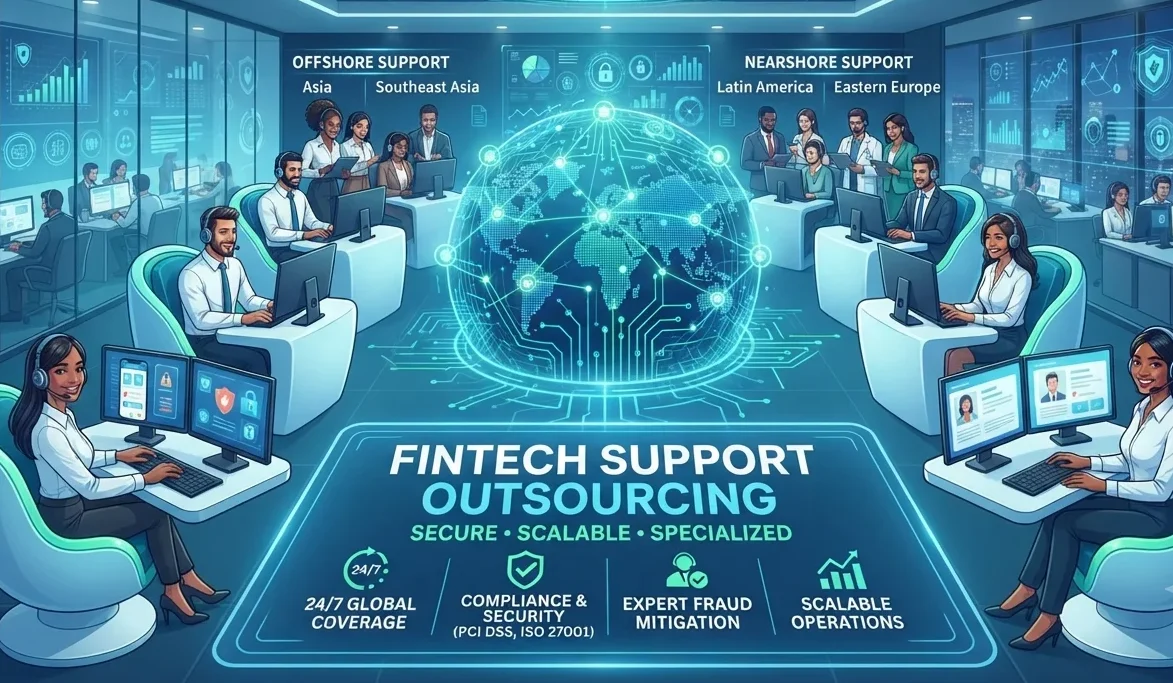
Consult with RCC BPO today to explore our specialized nearshore and offshore solutions. RCC BPO for compliance-ready, multilingual CX support tailored for trading platforms and brokerages.
Nearshore vs. Offshore Support Services for FinTechs
Scaling secure operations requires choosing the optimal delivery model to balance cost efficiency and cultural proximity.
Offshore Support: Scalability and Cost Efficiency
Offshore delivery centers absorb massive transaction surges without inflating overhead.
- Best For: 24/7 Tier-1 ticket triage, high-volume transactional queries, chat support, and background fraud monitoring.
- Strategic Advantage: Delivers round-the-clock (24/7/365) global coverage so a midnight security alert anywhere in the world is always answered by a live professional.
Nearshore Support: Cultural Proximity and Linguistic Nuance
Nearshore centers offer closer time zone and cultural alignment with primary user bases.
- Best For: Complex Tier-2 dispute resolution, voice-based fraud investigations, and regional regulatory management.
- Strategic Advantage: Minimizes communication barriers, eliminates awkward language gaps, and matches the fast-paced expectations of Western financial markets.
Frequently Asked Questions (FAQs)
Q1: Why do automated fraud tools need human analysts in FinTech support?
Automated tools and AI excel at volume scanning, but they lack situational context and emotional intelligence. They frequently miss social engineering schemes, authorized push payment (APP) fraud, and multi-factor authentication (MFA) nuances where a human analyst is required to evaluate behavioral cues and safely resolve the dispute.
Q2: How does fintech outsourcing help companies scale securely?
Fintech outsourcing allows digital-first brands to rapidly scale their operations without investing heavily in hiring, training, and infrastructure. Specialized partners provide certified fraud analysts, 24/7 coverage, and strict regulatory compliance frameworks.
Q3: What security standards should you look for when choosing call center support for fintech companies?
Decision-makers should partner with BPOs that maintain PCI DSS Level 1 compliance for cardholder data, ISO 27001 for information security management, and utilize advanced protective measures such as DTMF masking to eliminate sensitive data exposure.
Q4: What is the difference between nearshore and offshore financial tech support?
Offshore support centers offer massive cost efficiency and 24/7 global coverage for high-volume Tier-1 triage. Nearshore centers provide closer time zone alignment, cultural proximity, and shared linguistic nuance, which is ideal for complex Tier-2 dispute resolution and high-stress fraud investigations.
Q5: How does specialized customer support for fintech companies improve user retention?
When a customer experiences a security scare or account lockout, a fast, empathetic, and knowledgeable human response mitigates panic. Resolving these crises smoothly turns a potential churn event into long-term brand loyalty.
Delivering Resilience Through Specialized Financial Tech Support
Providing secure call center support for fintech companies requires treating customer support as a retention driver rather than a cost center. When a user faces a financial security crisis, they need a knowledgeable human expert who can restore their peace of mind. Partnering with an experienced provider like RCC BPO equips your platform with resilient, compliant, and scalable financial tech support solutions—protecting user retention, safeguarding assets, and turning critical security queries into long-term brand loyalty.