
Fixing eKYC Drop-Off in Cross-Border Onboarding: How a Fintech Outsourcing Support Team Can Help
In the hyper-competitive global fintech ecosystem, user acquisition is only half the battle—conversion at the onboarding stage defines long-term market leadership. For Chief Executive Officers (CEOs), Chief Operating Officers (COOs), Chief Risk Officers (CROs), and CX Directors, few operational metrics are as frustrating as eKYC drop-off during multi-jurisdiction onboarding.
When expanding cross-border across North America, Europe, LATAM, and APAC, fintech platforms encounter an intricate web of localized identity verification regulations, regional document formats, and varying user expectations. When automated Electronic Know Your Customer (eKYC) workflows encounter unfamiliar identity cards, non-standard address formats, or subtle biometric discrepancies, the default reaction is automated rejection or delayed manual processing.
For the modern fintech executive, learning how to reduce eKYC drop-off in cross border onboarding is critical. High onboarding friction translates directly to wasted customer acquisition costs (CAC), lowered conversion rates, and lost market share.
This comprehensive guide explores actionable fintech eKYC drop-off solutions, detailing how enterprise leaders can restructure their multi-jurisdiction onboarding CX by combining advanced automation with specialized human in the loop KYC verification for fintechs. By leveraging strategic cross-border KYC compliance outsourcing and dedicated AML back-office support, companies can manage multi country identity verification friction and turn compliance into a competitive growth driver.
The Strategic Challenge: Multi-Jurisdiction eKYC Friction
Automated eKYC solutions rely on machine learning models trained on specific document sets and structured data schemas. However, expanding a digital banking, remittance, or WealthTech platform into multiple international markets exposes structural limitations in purely automated systems.
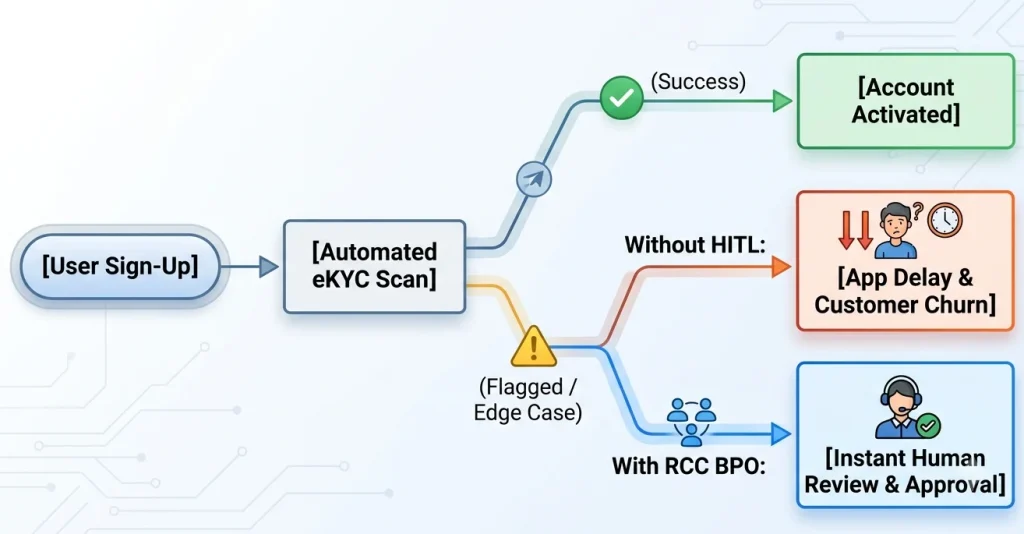
Key Drivers of Cross-Border Onboarding Drop-Off:
- 1. Regional Document Heterogeneity: National identity documents vary significantly between regions. While European passports feature standardized machine-readable zones (MRZ), driver’s licenses and regional IDs across Asia-Pacific and Latin America often utilize localized characters, non-standard fonts, or missing barcodes that confuse automated Optical Character Recognition (OCR) systems.
- 2. Localization & Language Barriers: When automated identity verification flags an issue—such as a blurred document, missing tax ID, or secondary proof of address requirement—users often receive generic, unlocalized error messages. Without immediate, native-language support from fintech customer support outsourcing teams, prospective customers abandon the registration process entirely.
- 3. Complex Cross-Border Regulatory Requirements: Compliance teams must align onboarding workflows with varying regulatory frameworks, including the EU’s Anti-Money Laundering Directives (AMLD) and GDPR, the US Bank Secrecy Act (BSA) and USA PATRIOT Act, alongside localized Monetary Authority of Singapore (MAS) and Financial Conduct Authority (FCA) guidelines. Unifying these rules within a single automated pipeline creates rigid checks that disproportionately flag legitimate users.
- 4. False Positive Frustration: System over-flagging causes legitimate, high-value users to be funneled into lengthy manual review queues. Without specialized eKYC BPO services providing a 24/7 dedicated back-office verification team, manual checks can take anywhere from 24 to 72 hours—well past the window of user intent.
Comparative Analysis: Native Automation vs. Hybrid HITL Model
The table below outlines how relying exclusively on automated eKYC compares to implementing a hybrid model backed by specialized bpo solutions for fintech onboarding compliance across key operational dimensions:
| Operational Dimension | Purely Automated eKYC | Multi-Jurisdiction Hybrid Model (Automation + RCC BPO) | Executive Impact |
|---|---|---|---|
| Edge-Case Document Processing | High failure rate on non-standard regional IDs | Instant human-in-the-loop review within < 5 minutes | Prevents user drop-off & protects marketing CAC |
| Global Language Coverage | Limited to system default UI languages | Native multilingual agents in 15+ languages via live chat | Enhances user trust across diverse international markets |
| Onboarding Turnaround Time (TAT) | Seconds for pass; 24–72 hours for manual flags | Under 10 minutes for 98% of flagged accounts | Boosts conversion rate and lifetime value (LTV) |
| Regulatory Compliance & Auditability | Standard algorithmic logging | Dual-layer quality assurance with full audit logs | Meets stringent FCA, MAS, FINMA, and BaFin standards |
| Scalability During Growth Spikes | Unlimited digital throughput, but manual backlogs compound | Dynamic scaling of certified back-office verification specialists | Eliminates operational bottlenecks during market launches |
| Customer Support Integration | Disconnected ticketing or bot response | Unified omnichannel support (Chat, In-App, Email, Call) | Delivers a frictionless first impression |
Why Executive Leadership Needs Strategic CX Outsourcing for eKYC
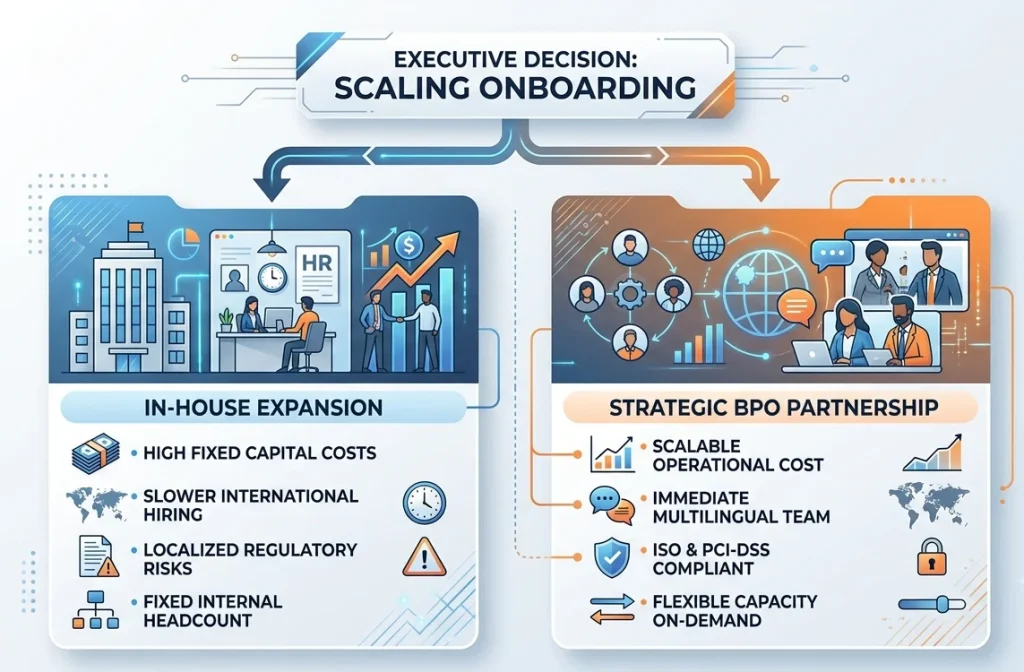
For Chief Operating Officers and Heads of Digital Transformation, scaling internal compliance and verification teams across multiple time zones and language requirements presents significant operational costs and management overhead.
1. Capital Allocation & Cost Efficiency
Building round-the-clock, multilingual verification desks in high-cost onshore markets significantly increases fixed operational expenditures. Partnering with a specialized KYC outsourcing vendor transforms fixed payroll and infrastructure costs into a flexible operational model that scales dynamically based on account application volumes.
2. Immediate Access to Compliance Talent
Recruiting, onboarding, and continually training compliance agents on multi-country AML/KYC directives requires substantial managerial resources. A dedicated BPO partner maintains a pre-trained workforce fluent in global identity documentation, biometric anomaly detection, and fraud pattern identification.
3. Continuous 24/7 Processing Across Time Zones
Cross-border users sign up continuously across global time zones. A localized back-office team operating within a single time zone inevitably introduces overnight processing delays. Global BPO hubs provide continuous, 24/7/365 coverage, ensuring that applications submitted in any region are reviewed and activated within minutes.
4. Focus on Core Product Innovation
Fintech leadership teams should focus their engineering and strategic resources on refining core financial products, expanding banking partnerships, and driving customer acquisition. Offloading back-office verification workflows and edge-case dispute handling to RCC BPO fintech specialists frees internal resources to focus on core platform growth.
Strategic Advantage: Scaling Onboarding with RCC BPO
As a trusted partner in Business Process Outsourcing for global financial services, RCC BPO delivers specialized Fintech CX and back-office verification frameworks engineered specifically for high-growth fintechs, neobanks, digital lenders, and cross-border payment platforms.
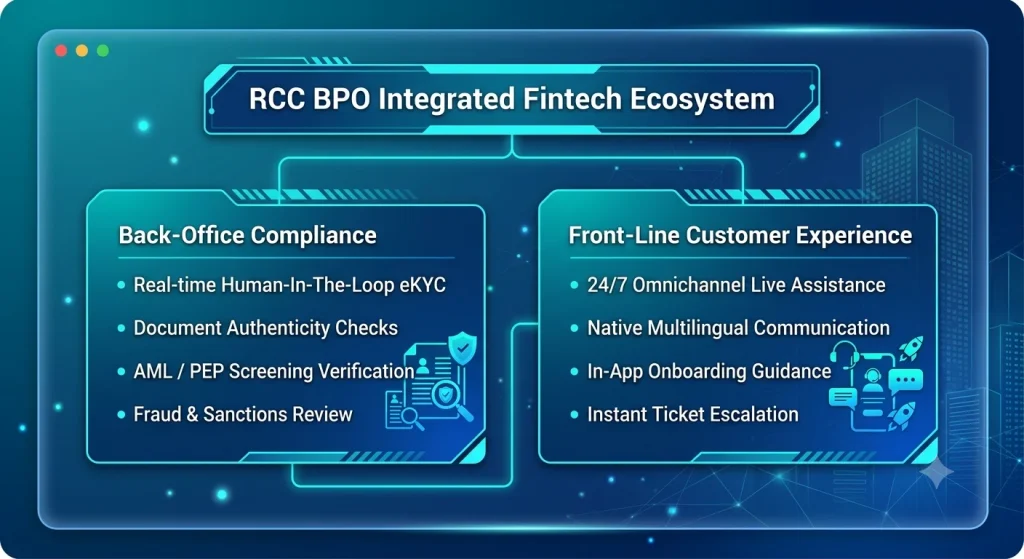
Key Capabilities Delivered by RCC BPO:
• Real-Time Human-in-the-Loop (HITL) Verification: RCC BPO integrates directly into your existing CRM, admin portal, or identity management platform via secure APIs. When automated OCR or biometric software flags an anomaly, our certified compliance agents review the document, cross-reference regional databases, and approve or request specific adjustments in real time.
• Native Multilingual Customer Assistance: If a prospective customer encounters an issue uploading proof of address or completing secondary verification, RCC BPO’s multilingual support representatives engage directly via live chat or in-app messaging to guide them through the process in their preferred language.
• Enterprise-Grade Security & Regulatory Compliance: RCC BPO operates within rigorous security frameworks, maintaining strict compliance with PCI-DSS, ISO 27001, and SOC 2 Type II standards. Data access is strictly controlled through role-based permissions and secure virtual environments, ensuring total adherence to global privacy laws like GDPR.
• Flexible Operations & Dynamic Scalability: Whether you are launching in a new geographic market, executing a major marketing campaign, or experiencing seasonal transaction surges, RCC BPO allows you to scale agent capacity up or down on demand without compromising processing speed or service level agreements (SLAs).
Mobile Responsiveness & Multi-Device Optimization Framework
Over 78% of digital financial account creations globally occur via mobile smartphones. An eKYC workflow that is not fully optimized for mobile devices guarantees high abandonment rates.
When designing the onboarding journey, executive teams must ensure that both automated software tools and human support channels operate seamlessly across mobile viewports:
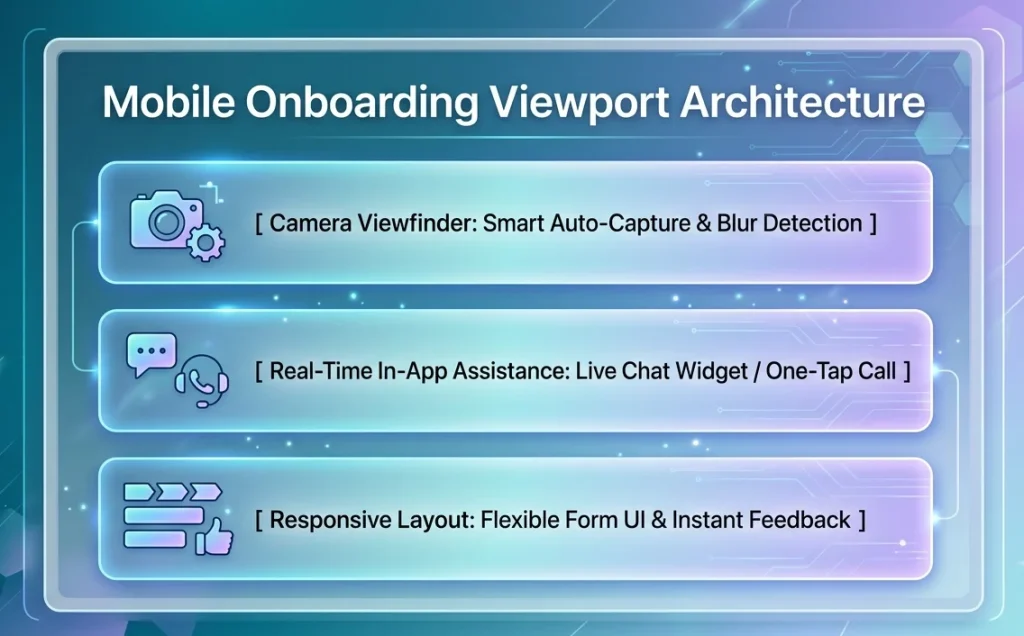
Mobile UX & CX Requirements for Global Onboarding:
- Intelligent Capture UI & Camera Integration: Mobile apps should incorporate auto-capture functionality with real-time feedback—instructing users on lighting conditions, glare reduction, and document positioning before the image is submitted for review.
- Embedded In-App Assistance Widgets: If an application requires manual review or additional documentation, the mobile interface must feature a non-intrusive live chat button or callback request widget. Users should never be forced to leave the mobile app to check external email threads for status updates.
- Lightweight SDKs & Speed Optimization: Onboarding screens must load rapidly across various network environments, including 3G and 4G mobile connections in developing markets. Unnecessary script delays during the document upload step directly increase bounce rates.
- Touch-Friendly Form Design & Auto-Fill Integration: Minimize manual text entry on mobile keyboards. Utilize auto-fill APIs, location auto-detection, and clear touch targets for dropdown menus to reduce user effort.
Transform Onboarding Compliance into a Competitive Advantage
Cross-border expansion offers massive revenue potential for forward-thinking fintech companies, but success hinges on delivering a frictionless first impression. High eKYC drop-off during multi-jurisdiction onboarding is an operational challenge that cannot be solved by automated algorithms alone.
By combining cutting-edge automation with RCC BPO’s strategic Human-in-the-Loop verification teams, multilingual customer support, and robust compliance infrastructure, fintech leaders can eliminate onboarding bottlenecks and reduce CAC waste.
Frequently Asked Questions (B2B Enterprise Queries)
Q1: How does an outsourced Human-in-the-Loop (HITL) model reduce eKYC drop-off rates?
An outsourced HITL model ensures that whenever an automated eKYC check fails or flags an edge case (e.g., poor lighting, non-standard regional ID, minor name discrepancy), the application is immediately routed to a specialized back-office agent. The agent reviews the document within minutes and assists the user via live chat, preventing the user from abandoning the app due to long waiting periods or automated rejections.
Q2: Can RCC BPO integrate directly with our proprietary fintech software stack?
Yes. RCC BPO support and compliance teams work directly within your existing technology ecosystem—including CRM tools (Salesforce, Zendesk, Freshdesk), core banking systems, identity platforms (Jumio, Onfido, Veriff, Persona), and custom admin dashboards via secure API connections and encrypted virtual desktop infrastructure (VDI).
Q3: How do you maintain data privacy and compliance across multiple international jurisdictions?
RCC BPO adheres to international security standards, including ISO 27001, SOC 2 Type II, PCI-DSS, and GDPR parameters. Verification personnel operate under strict data privacy protocols, zero-footprint workstation policies, and role-based access controls to ensure that sensitive customer Personally Identifiable Information (PII) is accessed securely and never stored outside authorized environments.
Q4: How quickly can RCC BPO scale up a dedicated back-office verification team for a new market launch?
With pre-screened talent pools and structured onboarding modules focused on financial services, RCC BPO can deploy specialized, multilingual back-office and customer support units within 2 to 4 weeks, complete with customized workflows aligned with your market launch timelines.
Q5: What key metrics should fintech CXOs track to evaluate onboarding success?
Fintech executives should focus on First-Time Pass Rate (FTPR), Overall Onboarding Conversion Rate, Average Verification Turnaround Time (TAT), Customer Acquisition Cost (CAC) Leakage Rate, and First Contact Resolution (FCR) for onboarding queries.