
In-House vs Outsourced Collections Support: A Cost-to-Serve Model for $1B–$50B Financial Institutions
For a bank, credit union, or specialty lender sitting between $1 billion and $50 billion in assets, the in-house vs outsourced collections decision rarely gets decided on a single number. It gets decided — or more often, delayed — because most cost comparisons circulating in the industry are built for institutions of a completely different size. Community-bank benchmarks understate the compliance overhead a mid-size institution carries. Tier-1 bank case studies assume a scale of resources most $5B–$20B institutions don’t have. What’s been missing is a cost-to-serve model built specifically for the institutions in between — and that’s what this article walks through.
What “Cost-to-Serve” Actually Means for Collections
Cost-to-serve is not the same question as “what does an agent hour cost.” It’s the fully loaded cost of resolving one delinquent account to a defined outcome — payment, arrangement, charge-off, or compliant closure — including every cost that shows up around the collections floor rather than on it.
For collections specifically, that means accounting for:
- Direct labor (wages, benefits, payroll tax, overtime during delinquency spikes)
- Technology stack (dialer/CRM licensing, call recording, QA platforms, PCI-scoped infrastructure)
- Compliance overhead (FDCPA and Regulation F training, state-by-state licensing, ongoing monitoring)
- Management layers (team leads, QA analysts, compliance officers dedicated to the collections function)
- Turnover cost (recruiting, onboarding, and the productivity gap during ramp-up)
- Opportunity cost of management attention diverted from core banking functions
Most internal cost comparisons stop at direct labor. That’s the single biggest reason in-house collections looks cheaper on paper than it performs in practice.
The True Cost of In-House Collections at $1B–$50B Scale
At this asset range, an institution typically isn’t large enough to fully amortize compliance and technology overhead the way a top-20 bank can, but it’s also too large to run collections as a small, informal function. That middle position is where cost-to-serve tends to be least visible internally.
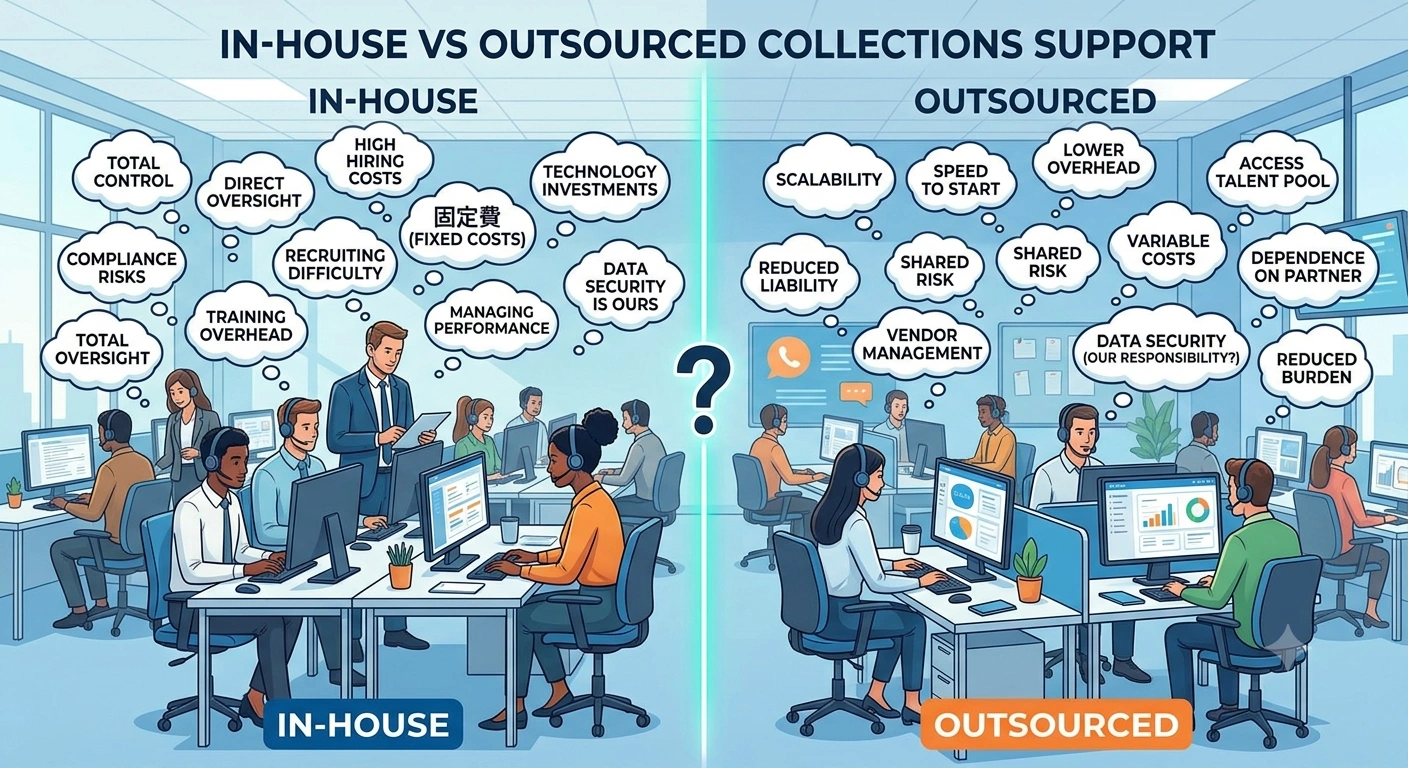
Fixed costs that don’t scale down with volume
- A dedicated compliance/QA function is required regardless of whether you’re managing 5,000 or 50,000 delinquent accounts
- Dialer and CRM licensing is typically priced in bands that penalize mid-size seat counts
- State collection agency licensing and renewal costs apply per state regardless of account volume in that state
Variable costs that spike unpredictably
- Seasonal delinquency increases (post-holiday, tax season, economic downturns) require rapid headcount flexing that in-house teams structurally cannot do without over-hiring in advance
- Agent attrition in collections roles frequently runs well above the institution’s overall employee attrition rate, and each departure resets training and quality ramp-up
The combined effect is that in-house collections costs are usually understated during planning and overrun during execution — not because of poor management, but because the fixed-cost floor is high and the variable-cost ceiling is difficult to control internally.
The Cost Structure of Outsourced Collections
Outsourced collections shifts the cost profile from fixed to variable, but the comparison is only meaningful if it’s built on comparable inputs. A credible outsourced cost-to-serve model should isolate:
- Cost per resolved account, not cost per contact or cost per hour — resolution is the unit that matters to a CFO
- Cost of compliance infrastructure already amortized across the vendor’s client base (FDCPA/Reg F training, licensing, QA systems) rather than built new for a single institution
- Scalability cost — what it actually costs to flex volume up 30% during a delinquency spike, and how quickly that capacity is available
- Recovery-rate impact, since a lower cost-per-contact that also lowers recovery rate is not actually a savings
This is the point where many institutions stop the comparison too early — at cost per contact — instead of continuing it through to cost per dollar recovered, which is the number that should be driving the decision.
Building the Cost-to-Serve Model: A Practical Framework
Use this structure to build a defensible internal comparison rather than relying on vendor-supplied percentage claims:
| Cost Component | In-House (typical structure) | Outsourced (typical structure) |
|---|---|---|
| Direct labor | Fixed FTE cost, fully loaded | Variable, volume-indexed |
| Compliance training & monitoring | Built and maintained internally | Amortized across vendor’s portfolio |
| Technology/dialer stack | Capital or license cost, fixed | Included or usage-based |
| State licensing | Direct cost per state | Vendor-held, cost-shared |
| Scaling for volume spikes | Requires lead time, over-hiring, or backlog | Contractually flexible capacity |
| Turnover/ramp-up cost | Borne fully by institution | Absorbed by vendor’s staffing model |
| Recovery rate impact | Baseline | Should be measured, not assumed |
The output of this exercise should be a single number: fully loaded cost per dollar recovered, calculated separately for early-stage and late-stage/post-charge-off collections, since the economics of the two differ substantially.
Beyond Cost: Recovery Rate, Compliance Risk, and Scalability
A cost-to-serve model that ignores recovery rate and compliance exposure isn’t actually a cost-to-serve model — it’s a labor-cost comparison wearing a cost-to-serve label.
Three factors that belong in the same model as the dollar figures:
- Recovery rate durability. A vendor with FDCPA-trained, financial-services-specific agents (not general-purpose customer service staff with a compliance module added) tends to sustain recovery rates because interactions are structured to stay within legal contact-attempt and disclosure requirements without losing the account relationship.
- Compliance exposure transfer. In-house collections concentrates regulatory risk inside the institution. Outsourcing distributes operational execution to a partner — but as covered in our companion piece on KYC/AML outsourcing liability, the institution retains ultimate regulatory responsibility regardless of who executes the call. The relevant question isn’t “does outsourcing reduce our liability” — it’s “does outsourcing reduce our operational risk of a violation occurring in the first place.”
- Elasticity. The ability to scale collections capacity up or down within weeks, not quarters, has real financial value during economic cycles. The value that rarely appears in a static cost comparison but shows up directly in charge-off timing and reserve requirements.
When In-House Collections Still Makes Sense
A cost-to-serve model should be honest about the cases where in-house remains the right call:
- Very high-touch, relationship-based commercial collections where the borrower relationship itself is a retention asset
- Institutions with existing underutilized internal capacity and low seasonal volatility
- Portfolios small enough that fixed compliance and technology costs are genuinely negligible relative to volume
Outsourcing is a capacity and cost-structure decision, not an ideological one — the model should point you to the right answer for your specific portfolio, not toward a predetermined conclusion.
A Decision Framework for CFOs and COOs
Before comparing vendor quotes, calculate three internal numbers:
- Your fully loaded in-house cost per dollar recovered, separated by early-stage and late-stage accounts
- Your delinquency volume volatility over the past three years (peak-to-trough ratio)
- Your current recovery rate benchmarked against FDCPA-compliant industry ranges, not just your own historical trend
With those three numbers, any outsourcing proposal can be evaluated on the same basis. It should be sold on a cost per dollar recovered, at your actual volume pattern, without compliance exposure hidden in the fine print.
Frequently Asked Questions
Is outsourced collections actually cheaper than in-house for a $1B–$50B institution?
Typically yes on a cost-per-dollar-recovered basis, primarily because compliance infrastructure and technology costs are amortized across a vendor’s broader client base rather than built for a single institution’s volume. The savings are less pronounced when measured only on cost-per-contact.
What’s the biggest hidden cost in in-house collections?
Compliance and QA infrastructure that has to exist regardless of account volume, combined with turnover-driven retraining costs — both of which are frequently excluded from internal cost comparisons.
Does outsourcing collections reduce our regulatory liability?
No. The institution remains responsible for regulatory compliance regardless of who performs the work. Outsourcing to a vendor with dedicated FDCPA/Reg F training and audit-ready documentation reduces the operational risk of a violation occurring, but the liability itself does not transfer.
How do we compare recovery rates fairly between in-house and outsourced models?
Measure cost per dollar recovered separately for early-stage and post-charge-off accounts. That requires any vendor comparison to be benchmarked against your own historical recovery rate, not an industry average.
RCC BPO provides FDCPA-compliant early-stage and late-stage collections support for banks, credit unions, and lenders in the $1B–$50B asset range, with audit-ready compliance documentation and volume-flexible U.S. and nearshore delivery.
Talk to our team about building a cost-to-serve model specific to your portfolio.