
The Nearshore Advantage: Why North American Financial Firms Prefer Nearshore BPOs for Secure Debt Collection
The financial services industry is navigating a more complex collections environment than ever before. Rising delinquency rates, stricter regulations, increasing cybersecurity risks, and higher customer expectations have fundamentally changed how lenders approach debt recovery. Today, successful collections are no longer measured solely by the amount recovered—they are also judged by compliance, customer experience, and operational efficiency. This shift is one of the key reasons why Nearshore BPOs have become the preferred outsourcing model for banks, credit unions, fintech companies, and other financial institutions across North America. By combining regulatory expertise, multilingual talent, secure technology, and geographic proximity, Nearshore BPOs enable lenders to recover outstanding balances while protecting customer trust and maintaining compliance with evolving financial regulations.
“The most successful financial institutions don’t view debt collection as a recovery function alone—they see it as an opportunity to protect customer relationships, strengthen compliance, and build long-term operational resilience through strategic nearshore partnerships.”
Why Debt Collection Has Become a Strategic Business Function
Debt collection has evolved significantly over the past decade. In the past, success was largely determined by recovery percentages and operational efficiency. While those metrics still matter, today’s financial institutions must also consider the overall borrower experience. Every conversation with a customer has the potential to either strengthen or weaken the relationship, making empathy and professionalism just as important as collection performance.
At the same time, regulatory oversight continues to expand. Organizations must comply with the Fair Debt Collection Practices Act (FDCPA), Consumer Financial Protection Bureau (CFPB) regulations, the Fair Credit Reporting Act (FCRA), the Telephone Consumer Protection Act (TCPA), and strict data protection requirements. Failing to meet these standards can result in significant financial penalties and reputational damage. As a result, debt collection outsourcing has become less about reducing costs and more about partnering with providers that possess deep expertise in financial services, compliance, and secure customer engagement.
Why Nearshore BPOs Are Becoming the Preferred Choice
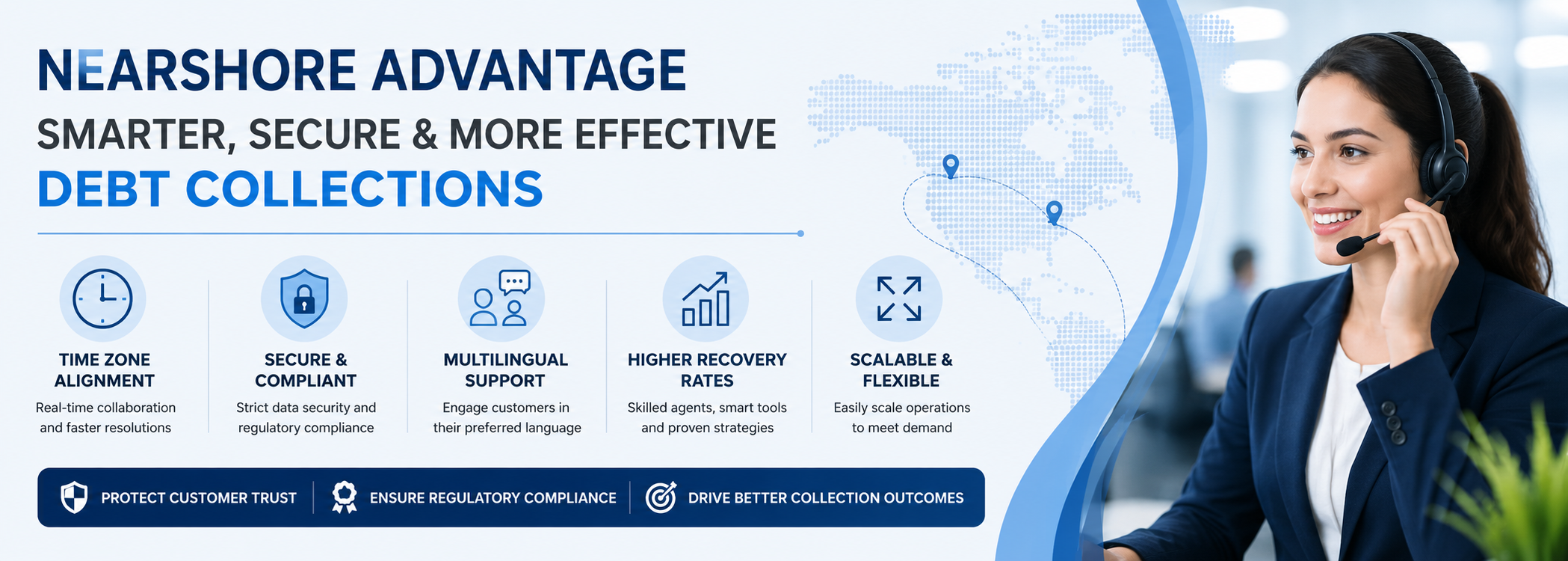
For many North American lenders, proximity matters. Unlike traditional offshore outsourcing models, Nearshore BPOs operate in neighboring countries such as Belize, Jamaica, Colombia, and El Salvador, allowing businesses to collaborate within similar business hours and cultural environments.
This alignment creates tangible operational advantages. Collection managers can communicate with outsourced teams in real time, compliance issues can be resolved quickly, and customer escalations receive faster attention. Instead of waiting overnight for responses, financial institutions benefit from seamless collaboration that improves productivity across the entire collections process.
Language capabilities further strengthen this model. Many nearshore providers offer bilingual and multilingual customer support, particularly in English and Spanish, enabling lenders to communicate more effectively with diverse borrower populations across the United States and Canada. Clear communication not only improves customer satisfaction but also increases the likelihood of successful repayment arrangements.
Compliance and Data Security Remain Non-Negotiable
Financial institutions handle highly sensitive customer information every day. Whether managing payment negotiations or reviewing account histories, protecting confidential financial data is an essential responsibility.
Experienced Nearshore BPOs invest heavily in secure infrastructure, encrypted communication channels, access controls, continuous monitoring, disaster recovery planning, and internationally recognized security standards such as PCI DSS and SOC 2. Equally important, they maintain rigorous quality assurance programs that ensure every customer interaction complies with industry regulations and internal governance policies.
This combination of compliance expertise and enterprise-grade security allows banks, fintech companies, and lending organizations to reduce operational risk while maintaining customer confidence. Rather than treating compliance as an administrative requirement, leading nearshore providers integrate it into every stage of the debt collection process.
Technology Is Redefining Modern Debt Collections
The digital transformation of financial services has significantly changed how collections are managed. Artificial intelligence, predictive analytics, workflow automation, and customer relationship management platforms now help lenders identify repayment opportunities faster and engage borrowers more effectively.
Modern collection specialists no longer rely solely on manual processes. Instead, they use intelligent systems that prioritize accounts based on payment behavior, recommend personalized repayment options, automate follow-up communications, and generate real-time performance insights. These technologies improve operational efficiency while allowing human agents to focus on meaningful conversations that encourage positive customer outcomes.
When technology is combined with experienced professionals, financial institutions can increase recovery rates without sacrificing service quality or regulatory compliance. This balance of automation and human expertise has become a defining advantage of high-performing nearshore outsourcing providers.
A Better Customer Experience Leads to Better Recovery Results
Many organizations underestimate the connection between customer experience and debt recovery. Borrowers who feel respected and understood are often more willing to engage in productive conversations and commit to realistic payment plans.
Nearshore teams are uniquely positioned to deliver this experience because they understand North American communication styles while offering multilingual support across multiple customer channels, including voice, email, chat, and SMS. Their ability to provide culturally aligned interactions helps reduce misunderstandings, improve first-contact resolution, and strengthen customer relationships during financially sensitive situations.
For lenders, this approach supports both revenue recovery and long-term customer retention. Rather than viewing collections as the final stage of the customer journey, forward-thinking financial institutions increasingly see it as another opportunity to reinforce trust.
Scalable Operations for an Unpredictable Financial Environment
Economic conditions can change rapidly, causing fluctuations in delinquency volumes and increasing pressure on internal collection departments. Expanding an in-house workforce often requires months of recruitment, training, compliance preparation, and infrastructure investment. For many financial institutions, this approach is neither practical nor cost-effective, particularly during periods of economic uncertainty.
Nearshore outsourcing offers a far more agile solution. Financial institutions can quickly scale collection operations to support first-party collections, early-stage delinquency management, payment reminder campaigns, accounts receivable management, dispute resolution, and customer support without disrupting business continuity. This flexibility enables organizations to respond to changing portfolio volumes while maintaining consistent service quality and regulatory compliance.
Whether managing seasonal demand or responding to unexpected market challenges, nearshore partners provide the operational resilience that lenders need to maintain high collection performance without placing additional strain on internal teams.
“Successful debt collection is no longer defined by how quickly payments are recovered. It is defined by how securely, compliantly, and respectfully financial institutions engage customers throughout the recovery journey.”
Why Strategic Nearshore Partnerships Deliver Long-Term Value
Today’s financial leaders evaluate outsourcing through a much broader lens than they did a decade ago. While cost optimization remains important, decision-makers increasingly prioritize regulatory compliance, cybersecurity, operational resilience, customer experience, and access to specialized financial services talent. As a result, outsourcing has evolved from a tactical business decision into a long-term growth strategy.
This shift explains why Nearshore Outsourcing Services continue to gain momentum within the banking and financial services industry. Instead of functioning as external vendors, experienced outsourcing providers become strategic extensions of internal operations, supporting lenders with secure debt collection outsourcing, multilingual customer engagement, quality assurance, workforce scalability, advanced reporting, and compliance-driven collection processes.
Organizations such as RCC BPO combine experienced financial services professionals with secure infrastructure, omnichannel customer engagement, bilingual support, and modern collection technologies to help banks, credit unions, fintech companies, mortgage lenders, and other financial organizations improve operational efficiency while maintaining exceptional customer experiences. This strategic partnership enables lenders to focus on core business growth while experienced specialists manage complex debt recovery operations with professionalism and regulatory expertise.
Frequently Asked Questions
1. What are Nearshore BPOs in financial services?
Nearshore BPOs are outsourcing providers located in neighboring countries that support banks, credit unions, fintech companies, and other financial institutions with debt collection, loan servicing, customer support, and back-office operations while working within similar time zones as North America.
2. Why do North American financial institutions prefer Nearshore BPOs for debt collections?
Financial organizations choose Nearshore BPOs because they provide stronger collaboration, multilingual customer support, regulatory expertise, enterprise-grade security, and faster communication than many traditional outsourcing models. These advantages improve recovery performance while maintaining compliance with industry regulations.
3. How do Nearshore BPOs improve debt collection performance?
Experienced nearshore providers combine skilled collection specialists with AI-powered analytics, omnichannel communication, workflow automation, and compliance monitoring. This enables lenders to engage borrowers more effectively, increase repayment rates, and enhance the overall customer experience while protecting regulatory compliance.
4. Are Nearshore BPOs secure enough for financial institutions?
Yes. Leading providers invest in enterprise-grade cybersecurity, encrypted communications, PCI DSS-compliant environments, SOC 2 security controls, role-based access management, and continuous monitoring to safeguard sensitive financial information and maintain customer trust.
5. What should lenders look for when choosing a Nearshore BPO partner?
Financial institutions should evaluate a provider’s experience in the BFSI sector, regulatory expertise, multilingual capabilities, technology platforms, cybersecurity standards, quality assurance processes, scalability, reporting transparency, and ability to integrate seamlessly with existing collection operations.
Building a Future-Ready Debt Collection Strategy with Nearshore Expertise
The future of debt collection extends far beyond recovering overdue payments. Financial institutions now require partners that can deliver secure operations, regulatory compliance, multilingual customer engagement, and technology-driven efficiency while protecting customer trust. As lending portfolios continue to grow and regulatory expectations become more demanding, Nearshore BPOs offer the expertise, flexibility, and operational resilience needed to navigate these challenges successfully.
For banks, credit unions, fintech companies, mortgage lenders, and other financial organizations across North America, partnering with an experienced provider such as RCC BPO represents more than an outsourcing decision. It is a strategic investment in sustainable business performance. With deep expertise in financial services, secure delivery infrastructure, bilingual professionals, and scalable collection solutions, RCC BPO empowers organizations to improve recovery rates, strengthen compliance, enhance customer relationships, and build future-ready debt collection operations that support long-term growth.
Share Now: