
How Outsourced Technical Support Improve Financial Operations efficiency?
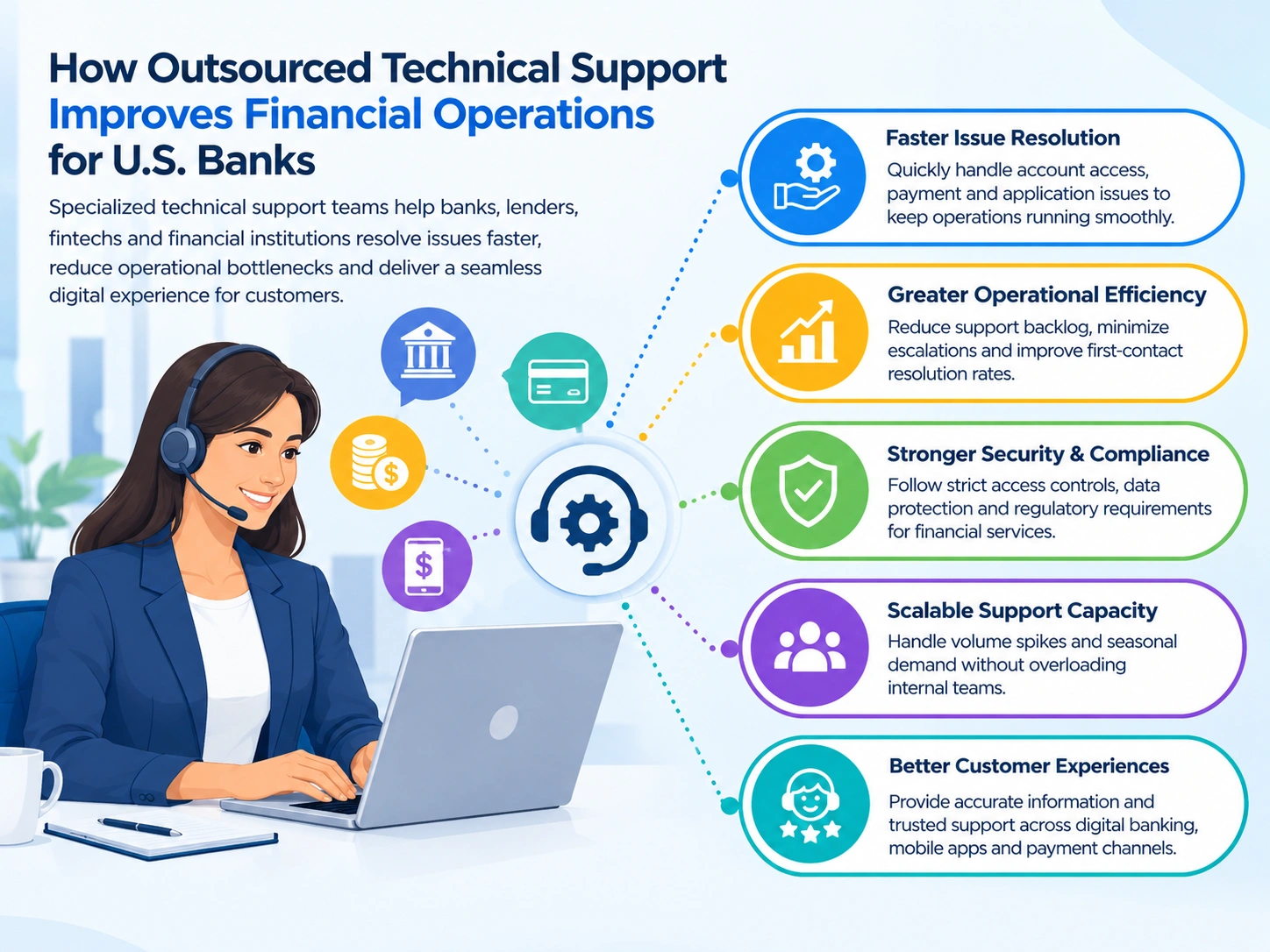
Financial institutions increasingly depend on digital banking platforms, payment systems, lending applications, mobile apps, customer portals, and interconnected financial technologies. When these systems experience access problems, transaction failures, application errors, or service interruptions, technical support becomes an important part of financial operations.
What Is Technical Support in Financial Services?
Technical support in financial services involves helping customers, employees, and business teams resolve technology-related problems associated with financial products, platforms, applications, payment systems, and digital channels.
For a bank, this may include troubleshooting online banking login problems, mobile application errors, password and authentication issues, payment problems, account access difficulties, and digital banking navigation.
A fintech company, technical support may involve application errors, wallet issues, payment failures, API-related problems, onboarding difficulties, authentication issues, card problems, and platform-related customer requests.
For lenders, technical support can include assistance with loan portals, borrower applications, document-upload problems, account access, payment interfaces, and servicing platforms.
The important distinction is that financial technical support is not simply an IT help desk. The support team needs to understand the financial product, customer journey, technology platform, escalation process, and operational impact of the issue.
Why Technical Support Matters to Financial Operations
Modern financial operations depend heavily on technology. A bank may rely on core banking platforms, digital banking applications, payment networks, CRM systems, loan origination platforms, customer portals, authentication tools, and multiple third-party integrations.
When a technical problem affects one of these systems, the impact can move quickly through the organization.
| Technical Issue | Potential Operational Impact |
|---|---|
| Online banking login failure | Higher contact volumes and additional authentication support |
| Payment failure | Customer complaints, repeat contacts and payment-related investigations |
| Mobile application error | Reduced digital adoption and increased support demand |
| Loan portal issue | Delayed applications, document submission or borrower servicing |
| Authentication or password issue | Account access problems and additional support interactions |
This is why financial technical support should be viewed as part of operational continuity rather than simply a customer service function.
Common Technical Support Challenges for Financial Institutions
High Volume of Technical Requests
Banks and fintechs can receive large numbers of technical inquiries related to login problems, authentication, mobile applications, payment failures, card access, account navigation, and digital services.
When internal teams have to handle every request, technical support queues can grow quickly. This can increase response times and pull internal technology and operations employees away from higher-value responsibilities.
Complex Financial Technology Environments
Financial institutions rarely operate a single technology platform. Customer journeys can involve multiple applications and systems. A support agent therefore needs to understand not only the customer’s immediate problem but also where that problem sits within the broader financial workflow.
Security and Authentication Requirements
Financial technical support involves sensitive information. Account access, identity verification, payment information, authentication, and customer records require controlled processes.
Support teams must therefore work within defined access permissions and escalation procedures rather than treating every technical problem like a conventional consumer technology help-desk ticket.
24/7 Customer Expectations
Digital financial services are available around the clock. Customers may encounter technical problems outside traditional banking hours, making continuous or extended technical support increasingly important for digital-first financial organizations.
How Outsourced Technical Support Improves Operational Efficiency
Outsourcing technical support allows financial organizations to create a dedicated support layer between customers and their internal technology or operations teams.
Instead of sending every technical question directly to internal IT, application, or operations specialists, a trained technical support team can troubleshoot common problems, provide approved assistance, document the issue, and escalate cases that require specialized intervention.
A typical technical support workflow
- Customer or employee reports a technical problem.
- Support team authenticates the request according to approved procedures.
- Agent identifies the issue using documented troubleshooting workflows.
- Approved resolution is provided where possible.
- Unresolved or sensitive issues are escalated to the appropriate internal team.
- The interaction and resolution are documented for quality and reporting purposes.
This structure can reduce unnecessary escalation, improve response times, provide greater visibility into recurring issues, and allow internal financial and technology teams to concentrate on complex problems.
Technical Support Services for Banks, Fintechs, and Lenders
Financial technical support can cover multiple operational environments. The exact scope should be designed around the financial institution’s products, systems, customer journey, and escalation requirements.
Account Access Support
Login assistance, password resets, account navigation, authentication issues, and approved access-related troubleshooting.
Digital Banking Support
Online banking and mobile application troubleshooting, navigation assistance, and digital service support.
Payment Support
Support for failed, pending, declined, or delayed payment and transaction-related technical inquiries.
Application Support
Troubleshooting for financial applications, portals, digital lending platforms, and customer-facing systems.
Incident Management
Issue intake, categorization, documentation, escalation, communication, and resolution tracking.
Technical Help Desk
Structured Tier 1 support with defined escalation paths for more complex technical problems.
Digital Banking and Mobile Banking Technical Support
Digital banking has changed the technical support expectations of financial customers. Customers may expect to open accounts, transfer money, make payments, check balances, manage cards, upload documents, and communicate with their financial institution through digital channels.
When a mobile banking application stops working or a customer cannot authenticate successfully, the issue can quickly become a customer experience problem.
Outsourced digital banking technical support can provide first-line assistance for issues such as:
- Mobile application navigation
- Login and authentication problems
- Password and access issues
- Digital account setup assistance
- Transaction and payment inquiries
- Application errors and troubleshooting
- Escalation of unresolved technical incidents
The objective is not to replace the financial institution’s technology team. Instead, technical support creates a structured operational layer that handles appropriate requests before escalation.
Payment and Transaction Technical Support
Payment technology creates another important technical support requirement for banks, fintechs, payment providers, and digital financial platforms.
Customers may contact support because a payment appears pending, a transfer failed, a card transaction was declined, a refund has not appeared, or a payment-related feature is not working as expected.
A financial technical support team can collect the relevant information, verify the customer’s identity according to approved procedures, provide permitted status information, troubleshoot known technical issues, create support cases, and escalate situations requiring payment, fraud, compliance, or technology specialists.
Technical Support for Fintech Operations
Fintech companies often operate technology-first financial products. Their customer experience depends heavily on the reliability and usability of applications, wallets, payment platforms, lending portals, digital accounts, and APIs.
As fintech user volumes increase, internal product and engineering teams can become overwhelmed by repetitive customer-facing technical questions.
A specialized fintech technical support team can provide the first operational response while keeping engineering resources focused on product development, infrastructure, integrations, and complex incidents.
Fintech technical support may include:
- Digital wallet support
- Payment application support
- Digital lending platform support
- Account registration assistance
- Authentication and MFA troubleshooting
- Transaction-related technical inquiries
- Application troubleshooting
- Technical case management
Scaling Financial Technical Support Without Overloading Internal Teams
Technical support demand is rarely constant. Financial organizations can experience sudden increases in support volume following application updates, product launches, security changes, payment disruptions, seasonal activity, or rapid customer acquisition.
Maintaining enough internal staff to cover every possible volume increase can be expensive and operationally inefficient.
Outsourced technical support provides a way to build additional capacity around defined service requirements.
| Support Model | Operational Benefit |
|---|---|
| Dedicated Technical Support Team | Consistent product knowledge and dedicated operational ownership |
| 24/7 Technical Support | Extended coverage for digital financial services |
| Overflow Support | Additional capacity during high-volume periods |
| Tiered Technical Support | Routine issues handled at the first level while complex cases are escalated |
Security, Compliance, and Access Controls
Technical support in financial services requires careful attention to security. Support personnel may interact with account information, authentication workflows, transaction details, customer records, and financial applications.
Financial institutions should therefore evaluate how an outsourced technical support provider controls access to systems and information.
Important considerations include:
- Role-based system access
- Authentication and customer verification procedures
- Data handling and privacy controls
- Interaction monitoring and quality assurance
- Incident escalation procedures
- Audit trails and documentation
- Business continuity procedures
- Defined responsibilities between the institution and service provider
U.S. regulators have long emphasized that outsourcing technology and operational services does not eliminate the financial institution’s responsibility to manage third-party risk. The FDIC and FINRA both identify areas such as payment processing, customer account processing, loan processing, security monitoring, help desk operations, and call centers as activities that institutions may outsource while retaining responsibility for appropriate risk management and oversight.
Technical Support KPIs Financial Leaders Should Track
A financial technical support program should be measured using operational metrics rather than simply the number of agents assigned to the program.
| KPI | What It Shows |
|---|---|
| First Contact Resolution | How many technical issues are resolved without unnecessary repeat contact |
| Average Resolution Time | How long it takes to resolve technical support cases |
| First Response Time | How quickly customers receive an initial response |
| Escalation Rate | Percentage of issues requiring higher-level technical intervention |
| Technical Backlog | Number of unresolved technical support requests |
| SLA Compliance | Performance against agreed response and resolution targets |
| Customer Satisfaction | Customer perception of technical support quality |
These metrics help financial leaders understand whether technical support is actually improving operational performance or simply moving support requests from one team to another.
How to Choose a Financial Technical Support BPO
Choosing a technical support outsourcing partner for a financial institution requires more than comparing pricing. The provider should understand both technology support and the financial environment in which the technology operates.
Look for BFSI Experience
A provider familiar with banking, lending, fintech, payments, insurance, or other financial services is more likely to understand the operational sensitivity surrounding financial applications and customer information.
Evaluate Technical Support Capabilities
Ask whether the provider can support the specific technologies and workflows used by your organization. This may include digital banking platforms, mobile applications, payment systems, loan portals, CRM platforms, authentication systems, and customer support platforms.
Check Escalation Processes
Technical support is most effective when escalation is clearly defined. The provider should know which issues it can resolve, which require internal technology teams, and which must be transferred to specialized financial, fraud, compliance, or operational teams.
Review Security and Quality Controls
Financial institutions should evaluate access controls, monitoring, data protection, quality assurance, employee training, documentation, business continuity, and relevant security certifications or controls during vendor due diligence.
Demand Measurable Performance
A mature technical support partner should provide reporting around response time, resolution time, SLA performance, first-contact resolution, escalation rates, backlog, quality, and customer satisfaction.
Why Technical Support Is Becoming a Strategic Part of Financial Operations
Financial institutions are becoming increasingly dependent on digital experiences. Customers expect banking applications, payment platforms, lending portals, and financial services to work reliably whenever they need them.
As a result, technical problems can no longer be treated as isolated IT issues. Furthermore, a simple login failure can quickly become a customer service issue, while a payment error can escalate into a major operational issue. Similarly, a lending portal problem can delay an application, just as a mobile application outage can suddenly increase contact-center demand. Consequently, outsourced financial technical support creates a specialized operational layer that effectively connects technology, customer experience, and financial operations. Ultimately, the objective is straightforward: resolve appropriate technical issues quickly, escalate complex problems correctly, maintain clear visibility into recurring issues, and allow internal teams to focus on higher-value financial and technology responsibilities.
Frequently Asked Questions About Financial Technical Support
What is technical support in financial services?
Technical support in financial services plays a vital role by helping customers, employees, and financial organizations resolve technology-related issues involving banking applications, digital platforms, payment systems, account access, authentication, financial software, and other technology-enabled services. Furthermore, it ensures system reliability, safeguards sensitive financial data, and maintains uninterrupted compliance across digital operations.
Can banks outsource technical support?
Yes. Banks can outsource defined technical support activities such as digital banking assistance, application troubleshooting, account access support, password assistance, payment-related technical inquiries, incident intake, and first-level help desk support, subject to appropriate controls and vendor oversight.
What does a financial technical support team handle?
A financial technical support team can handle account access problems and online and mobile banking troubleshooting. In addition, they assist with payment and transaction inquiries, application support, and system navigation. Furthermore, their responsibilities include managing password resets, handling technical service requests, overseeing incident management, and directing defined technical escalations.
What is fintech technical support?
Fintech technical support assists users and operational teams with technology-related problems involving digital financial products such as payment applications, wallets, digital lending platforms, online accounts, authentication systems, and other fintech applications.
How does technical support outsourcing improve banking operations?
By incorporating outsourced technical support, companies can significantly reduce the workload on their internal technology and operations teams while providing vital additional support capacity. Consequently, this approach improves overall response times and enables coverage across extended hours. Furthermore, standardizing troubleshooting workflows creates clearer escalation processes, ensuring that technical issues are resolved efficiently and systematically.
Can technical support be provided 24/7 for financial services?
Yes, financial institutions can effectively leverage either dedicated or outsourced technical support models to provide extended or 24/7 coverage for digital banking, fintech, payment, lending, and other financial technology services. Furthermore, utilizing these flexible staffing strategies ensures that critical systems remain continuously monitored and operational, thereby minimizing downtime and boosting customer confidence around the clock.
Strengthen Your Financial Technical Support With RCC BPO
RCC BPO provides technical support services for banks, lenders, fintech companies, insurance providers, and other financial organizations. Our teams can support account access, online and mobile banking troubleshooting, payment and transaction inquiries, application support, system navigation, incident management, and technical service requests through structured financial support workflows.