


How Insurance Firms Can Keep Customers: The Long-Term Resilience Mandate in USA
When researching how insurance firms can keep customers, the data point that stands out most is “Time-to-Resolution.” According to the PwC 2026 Insurance Barometer, 84% of policyholders cite ease of claims as their primary reason for staying with a carrier, yet only 22% of firms have fully automated their middle-office workflows.
This creates what we call the “Integration Gap.” Policyholders experience a seamless front-end website, but once a claim is filed, they fall into a black hole of manual “redo-loops” and siloed data. To retain customers, insurance firms must ensure that their back offices move as quickly as customer expectations.
Closing the “Integration Gap” with Agentic AI
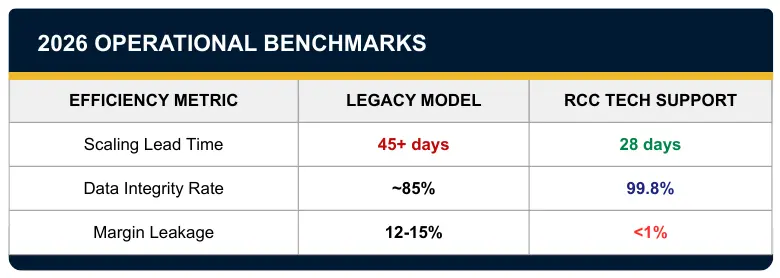
RCC BPO helps firms bridge this gap by replacing legacy manual intake with Agentic AI. Unlike standard automation, Agentic AI doesn’t just “read” a form; it understands the context of a claim, flags missing documentation immediately, and routes the file to the correct specialized adjuster. This ensures that the data moving from the contact center to the underwriter is 99.8% accurate, preventing the 3-5 day lag times that cause policyholder churn.
Using Data Transparency to Keep Insurance Customers Loyal
A primary reason customers leave is the feeling that their carrier isn’t acting in their best interest, especially during premium hikes. In 2026, the strategy for how insurance firms can keep customers close involves “Radical Transparency.”
Trust is built through Data Lineage. When a claim is denied or a premium is adjusted, the customer wants to know why. If your BPO partner cannot provide an audit-ready trail of how that decision was reached, the customer perceives the firm as a “black box.”
Proactive Trust vs. Reactive Service
- Audit-Ready Lineage: RCC provides a clear, SOC 2-compliant data trail for every claim decision.
- Predictive Trust: We use AI to flag potential delays before the customer even thinks to call.
- Dispute Reduction: Clearer data leads to a 15-18% reduction in litigation and settlement friction, which directly impacts the bottom line.
Scaling Contact Center Operations to Keep Customers During Volatility
Tumultuous times, such as the 2025 hurricane season or shifting global tariffs, create “Peak Demand” surges that break standard BPO models. If you want to know how insurance firms can keep customers during a catastrophe, the answer is Elastic Capacity.
Legacy BPOs take 6-8 weeks to onboard licensed adjusters. In a crisis, that is a lifetime. By the time the staff is ready, the customer has already canceled their policy. RCC BPO utilizes a “RapidResponse” framework that leverages AI-assisted training to get qualified associates into production in as little as four weeks without sacrificing the quality of the “Human Touch.”
The 2026 Shift: From Call Centers to Retention Engines
Modern insurance leaders must realize that the contact center is no longer just a “help desk.” It is the frontline of brand defense. How insurance firms can keep customers in 2026 requires a 360-degree view of the policyholder.
When an RCC associate speaks to a customer, they aren’t looking at a blank screen. They are powered by a real-time data engine that displays the customer’s history, risk profile, and likely “churn triggers.” By identifying that a customer is at risk of leaving before they express it, we enable proactive retention strategies like customized policy reviews or loyalty incentives.
The Role of Regulatory Compliance (SOC 2)
In 2026, data security is a retention feature. Policyholders are more aware than ever of cybersecurity threats. A firm that can guarantee its BPO partner is SOC 2 Type II compliant builds an extra layer of “unspoken trust.”
At RCC BPO, we treat compliance not as a checkbox but as the foundation of every customer interaction for end to end customer support in insurance.
Strategic Mastery of Customer Retention with RCC BPO
The secret of how insurance firms can keep customers lies in the transition from reactive service to institutional resilience. Tumultuous times do not break businesses; they break processes. By securing your back-office data and accelerating your claims velocity, you transform your operations into a fortress of loyalty.
The firms that thrive in 2026 will be those that realize the “back office” is actually the “heart of the customer experience.”
Optimize Your 2026 Retention Strategy
Is your current BPO partner eroding your customer loyalty through slow processing and high error rates? Stop the leakage and reclaim your margin with the RCC Standard.
Schedule a call with RCC BPO executives today to learn more about our services. Join the elite carriers using our SOC 2-compliant, AI-driven frameworks to increase retention by up to 24% and lower cost-per-claim by 32%.
FAQ: Insurance Retention & Operational Resilience
-
How does Agentic AI improve upon standard middle-office RPA?
Standard RPA follows rigid, rule-based logic that often fails when encountering unstructured data or complex claims. Agentic AI understands the broader context of an insurance claim, allows for autonomous decision-making, and can flag missing documentation instantly. This cognitive layer creates a “human-and-agent” workforce that can process complex workflows with up to 99.8% accuracy.
-
Why is “Data Lineage” critical for policyholder trust in 2026?
Data lineage provides a transparent, audit-ready map of a policyholder’s data throughout its lifecycle, from intake to final decision. In an era of “Radical Transparency,” showing customers exactly how their premiums or claims were calculated reduces litigation friction by 15-18%. This prevents the “black box” perception that often triggers mass policy cancellations during rate adjustments.
-
How does the “RapidResponse” framework handle catastrophe-driven surges?
Legacy BPO models typically require 6-8 weeks to scale staff during peak catastrophe (CAT) events, which is often too slow to maintain customer satisfaction. Advanced RapidResponse frameworks utilize AI-assisted training to prepare licensed associates for production in just four weeks. This elastic capacity allows carriers to respond to policyholders during critical windows of volatility without compromising service quality.
-
What role does SOC 2 Type II play in customer retention?
Cybersecurity has transitioned from a backend IT concern to a front-facing customer retention feature. An SOC 2 Type II attestation provides independent verification that a partner’s security controls—such as PII encryption and access management—operate effectively over time. Policyholders who feel their data is securely managed are significantly less likely to churn following high-profile industry data breaches.
-
How do specialized associates identify churn before a customer cancels?
By integrating predictive analytics with real-time data engines, associates can see “churn triggers”—such as frequent support contacts or missed payments—before they are verbalized. This allows teams to pivot to proactive retention strategies, such as personalized policy reviews or loyalty incentives, rather than react once a cancellation request is made. These proactive interventions can increase overall retention rates by up to 24% in competitive markets.