
Sustainable Risk Mitigation: The Security Benefits of EU-Aligned Albania BPO Centers
The North American financial landscape in 2026 operates under a “zero-trust” mandate. For Directors of Lending and Risk Compliance Officers in the U.S. and Canada, the primary challenge shifted from “Where is the talent?” to “Where is the data safe?” As a result, the search for a secure Albanian BPO center has become a strategic necessity for institutions navigating the intersection of rapid scaling and aggressive regulatory oversight.
Industry data highlights the urgency of this transition. According to Straits Research, the global BFSI BPO services market reached USD $130.26 billion in 2025 and is projected to grow to USD $269.63 billion by 2033, expanding at a 9.52% CAGR — driven by rising demand for customer support, KYC/AML compliance, fraud detection, and loan processing. Furthermore, according to Facts & Factors Research, the BFSI segment accounts for the largest share of the global BPO market at approximately 28% in 2025, reflecting the sector’s heavy reliance on outsourced compliance, customer support, and back-office operations. Consequently, the case for specialized outsourcing services to Albania has never been more compelling.
The Gold Standard: GDPR Compliance in an Albanian BPO Center
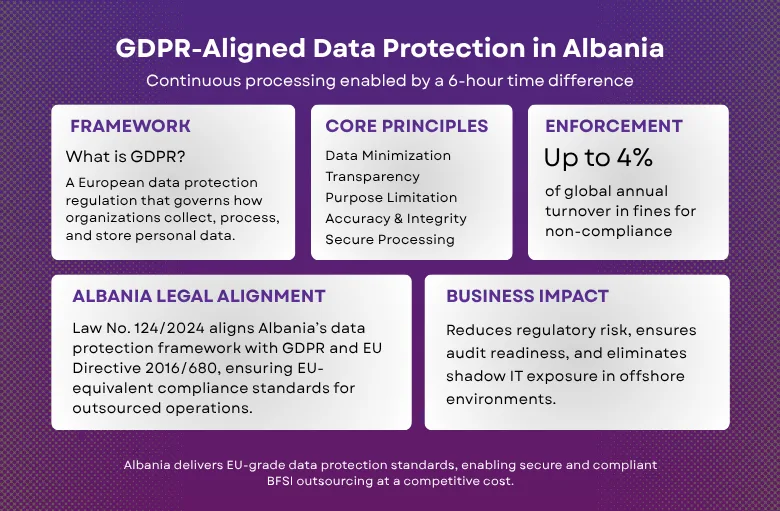
Security is no longer a peripheral feature — it is the core product. In January 2025, Albania brought Law No. 124/2024 “On Personal Data Protection” into full force. This landmark legislation formally aligned the Albanian legal framework with the European Union’s GDPR and Directive (EU) 2016/680. For a modern Albania BPO center, this alignment means that North American firms receive the same high-standard data protections found in Paris or Berlin, but at a competitive price point.
Furthermore, the Information and Data Protection Commissioner in Albania now has the power to impose administrative fines of up to 4% of global annual turnover for non-compliance — mirroring GDPR penalties. These strict penalties reflect a mature, pro-investment ecosystem. When U.S. and Canadian firms engage call center services in Albania, they leverage an infrastructure where transparency, data minimization, and integrity are legally mandated. Therefore, these firms effectively mitigate the “shadow IT” risks common in less-regulated offshore markets.
Strategic Stability for US and Canada Financial Services Outsourcing
North American institutions require more than just legal text — they require operational predictability. According to the World Bank, Albania’s economic reforms are accelerating convergence with EU standards, with GDP growth forecast at approximately 3.5% annually through 2026, one of the strongest rates in Europe. In 2026, the European Bank for Reconstruction and Development (EBRD) extended a €25 million portfolio risk-sharing guarantee to Albania’s Union Bank — the first facility of its kind in the country — signaling strong institutional confidence in the local financial infrastructure.
This stability is essential when you’re looking to outsource financial services. By utilizing an Albanian BPO center, Canadian firms benefit from a bilateral investment framework established through concluded negotiations with Canada on a Foreign Investment Promotion and Protection Agreement (FIPA), which provides a foundation for discussions on investor rights. Similarly, U.S. institutions find that Albania’s status as a NATO member since 2009 and its active path toward EU accession offer a geopolitical safety net that traditional Asian hubs cannot mirror in 2026. Consequently, your institution gains a delivery partner that operates within a Western-aligned, pro-investment ecosystem.
Precision Workflows: Banking and Insurance Claims Support
In 2026, the “Commodity BPO” is dead. Financial leaders now seek specialized outsourcing services in Albania that handle complex, high-stakes tasks. An Albania BPO center provides the technical expertise required for:
- KYC/AML Compliance: Agents utilize AI-assisted monitoring to verify identities and flag anomalies across North American jurisdictions.
- Loan Origination Support: Teams manage the full documentation lifecycle, ensuring accuracy from initial application to month-end closing.
- Fraud Detection: Real-time speech analytics and predictive tools identify anomalies before they impact the balance sheet.
- Insurance Servicing: Specialized agents handle First Notice of Loss (FNOL) and policy renewals with empathy and technical precision.
Moreover, Gartner projects that by 2026, conversational AI will reduce contact center labor costs by $80 billion globally. However, the winning model remains “AI-augmented human expertise.” Albanian agents, known for their high literacy and digital fluency, serve as the ideal human-in-the-loop to oversee these automated processes. Therefore, financial services outsourcing for US firms ensures that complex fraud disputes and sensitive borrower interactions receive the human attention they require.
The Multi-Regional Advantage: US and Canada Support
The diversity of the North American market demands a polyglot approach. While U.S. institutions require Spanish-language support, Canadian organizations often mandate English-French bilingualism to align with regulatory requirements. An Albanian BPO center delivers precisely these capabilities.
Albania’s education system emphasizes foreign languages from primary school, resulting in a workforce where over 50% of professionals speak at least two foreign languages fluently (Stealth Agents, 2025). Besides English, the country has a high density of Italian, German, and French speakers. According to Outsource Accelerator, Albania also has the third-highest tertiary enrollment rate (63%) among its peer countries — producing a consistent pipeline of graduates in business, law, and communications disciplines that align directly with BFSI support requirements.
This makes Albania one of the few European offshore markets that can realistically support financial services outsourcing for US and Canada simultaneously. Furthermore, Albanian agents combine strong language proficiency with a high level of cultural familiarity with Western professional standards — built through extensive exposure to U.S. and European media, education systems, and diaspora networks — thereby reducing communication gaps and improving the overall customer experience.
Operational Continuity and the 6-Hour Time Zone Asset
Operational resilience depends on continuous coverage. Albania operates at UTC+1, placing it 6 hours ahead of U.S. Eastern Standard Time (EST) in winter and 5 hours ahead during EDT. When you utilize call center services in Albania, this offset becomes a competitive asset.
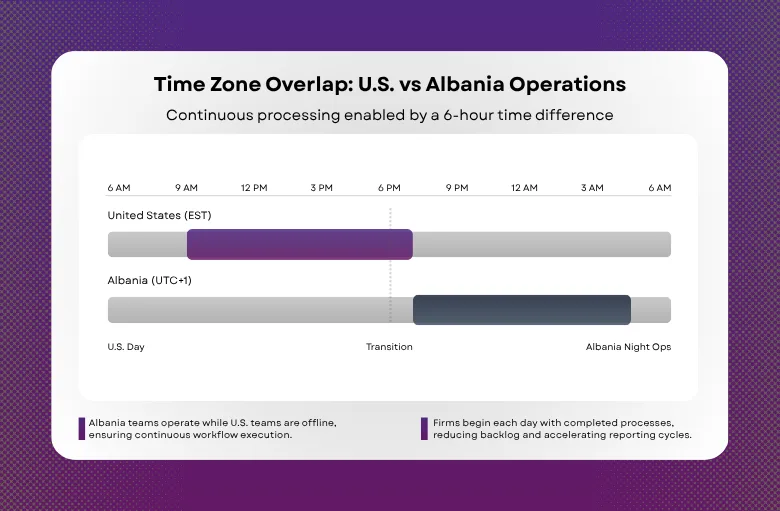
While your domestic teams are offline, Albanian teams perform back-office reconciliations, documentation processing, and extended fraud monitoring. As a result, your U.S. or Canadian operations start each business day with completed work rather than a backlog. This follow-the-sun model allows firms to reduce month-end closing cycles by up to five days, according to Complete Controller’s analysis of offshore financial processing models. Therefore, your leadership team gains faster access to monthly data, improving strategic decision-making.
The Future of Scaling: Why an Albanian BPO Center is Gaining Traction
For mid-market firms facing margin pressure, Albania’s cost-to-quality ratio is unmatched. According to BPO Search, labour costs in Albania run approximately 50–60% lower than in Western Europe. This directly translates to meaningful operational savings for U.S. and Canadian firms compared to fully onshore models. Unlike saturated markets, Albania offers a consistent pipeline of 40,000 new graduates annually. Most with IT, business, and engineering skills — who view BFSI support as a prestigious, high-growth career (BPO Search, 2025).
Furthermore, Albania’s BPO sector has recorded 15% annual growth over recent years (Stealth Agents, 2025), driven by the expansion of international BPO operators into the market. Today, over 3,000 ICT and BPO companies operate in Albania, including major international outsourcing brands that have established regional delivery centers in Tirana and Durrës (Helpware, 2025). This track record of attracting global enterprise clients demonstrates that an Albania BPO center can scale rapidly while maintaining the strict quality controls that financial regulators demand.
Frequently Asked Questions: US and Canada Financial Services Outsourcing
1. How does an Albania BPO center handle North American data privacy requirements?
+
Albania’s 2024 Data Protection Law aligns fully with the EU’s GDPR, ensuring a “Privacy by Design” approach.
This provides U.S. and Canadian firms with legally mandated transparency, data security, and accountability standards.
This provides U.S. and Canadian firms with legally mandated transparency, data security, and accountability standards.
2. Can call center services in Albania support Spanish and French for the U.S. and Canadian markets?
+
Yes, Albania is a multilingual hub where agents are proficient in English, Spanish, and French.
This allows for seamless coverage of the diverse North American demographic from a single delivery location.
This allows for seamless coverage of the diverse North American demographic from a single delivery location.
3. What specific workflows are best suited for outsourcing services to Albania?
+
High-stakes workflows like KYC/AML verification, loan servicing, fraud detection, and insurance claims are ideal.
These tasks leverage Albania’s highly educated workforce and strict, Western-aligned compliance frameworks.
These tasks leverage Albania’s highly educated workforce and strict, Western-aligned compliance frameworks.
4. Is financial services outsourcing for U.S. firms cost-effective compared to traditional hubs?
+
Yes, Albania offers a 40–60% cost reduction compared to onshore U.S. models while maintaining elite quality.
The region provides higher talent retention and better cultural alignment than many traditional Asian offshore locations.
The region provides higher talent retention and better cultural alignment than many traditional Asian offshore locations.
5. How does the 6-hour timezone difference benefit a Canadian financial institution?
+
The 6-hour offset enables a “follow-the-sun” model where Albanian teams handle back-office processing overnight.
This ensures Canadian offices start each business day with completed documentation and all queues cleared.
This ensures Canadian offices start each business day with completed documentation and all queues cleared.
Elevating Performance with Offshore Excellence – RCC BPO Albanian BPO Center
RCC BPO provides more than a workforce — we provide a security-hardened operational ecosystem. Our Tirana-based delivery center operates under PCI DSS, SOC 2 Type II, and ISO 27001 certifications. We integrate advanced technology, such as our proprietary Accent Harmonizer and AI-assisted quality monitoring, to ensure that every Albanian BPO center interaction meets your brand’s specific standards.
By partnering with RCC BPO, you align with a team that mirrors your North American compliance requirements and customer experience goals. We handle the heavy lifting of regulatory change and shifting demand so your internal staff can focus on high-value strategy.