


FDCPA Section 806: Mitigating Harassment in Debt Collection via Real-Time AI Monitoring in USA
In the 2026 regulatory environment, “Harassment” is no longer defined solely by “what” an agent says, but also by “how” they say it and “how often” they call. FDCPA Section 806 prohibits any conduct where the “natural consequence” is to harass, oppress, or abuse. This includes the obvious—profanity and threats—but also the “meaningless annoyance” caused by repeated ringing. For a CEO, the risk isn’t just a fine; it’s a viral social media post of a rogue agent that destroys decades of brand equity.
Addressing the “Clarity of Vision” Gap
Accenture’s 2026 Life Trends report highlights a significant gap: 62% of consumers say trust is the most crucial factor when choosing to engage with a brand, yet 64% of executives admit they prioritize cost over satisfaction. This misalignment often leads to high-pressure environments where agents inadvertently cross the line into harassment in debt collection. The result? A 500% faster accumulation of “AI and Organizational Debt” due to unmanaged risks.
The Global Dispute “Kill-Switch”
FDCPA Section 809(b) Compliance Architecture
DISPUTE DETECTED
📩
Trigger: Written Dispute Received
The consumer has the right to dispute the debt within 30 days of the G-Notice.
▼
GLOBAL CHANNEL FREEZE
📱VOICE DIALER
💬 SMS API
📧 EMAIL ENGINE
▼
Verification Workflow
- Obtain verification of debt from the creditor.
- System remains locked until the document upload timestamp is logged.
- Mail verification to the consumer.
Legal Shield: Failure to cease communication after a dispute is a direct violation of Section 809(b), leading to civil liability up to $1,000 per individual action.
2026 Resilience: AI-powered workflows ensure the “Kill-Switch” is applied to digital avatars and automated negotiators instantly.
Does your BPO have a real “Kill-Switch” for disputes?
RCC BPO’s automated Lock-Down protocol ensures that once a dispute is filed, all outreach stops until validation is mailed.
Operational Excellence: Real-Time Sentiment & Frequency Control
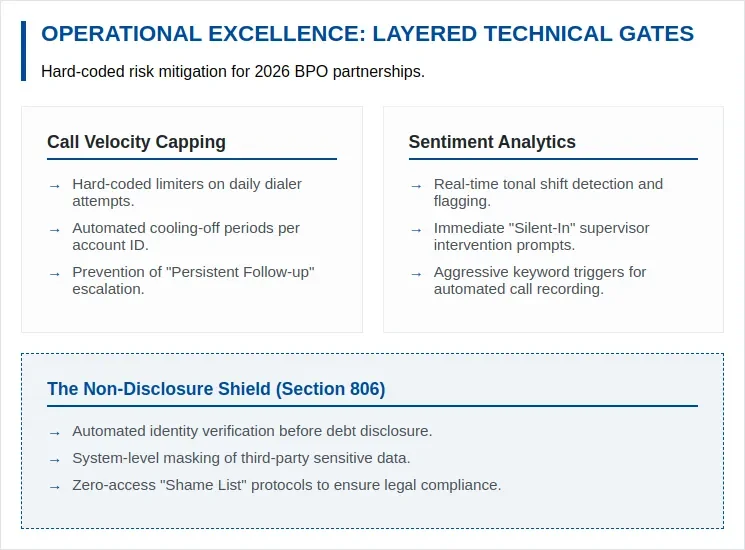
Preventing harassment requires more than a “Code of Conduct”; it requires real-time technical gates:
- Call Velocity Capping: Systems must be hard-coded to limit the number of call attempts per account per day. “Persistent follow-up” must never cross into “repeated ringing with intent to annoy”.
- Sentiment Analytics: Modern platforms listen for tonal shifts. The system provides a real-time “empathy prompt” when an agent’s volume rises. It also flags the call if it detects aggressive keywords. Supervisors then receive an alert for immediate “silent-in” intervention. This proactive monitoring ensures the team maintains professional standards during every call.
- The Non-Disclosure Shield: Section 806(3) strictly prohibits disclosing a debt to third parties. This rule also bans the use of “shame lists” to coerce payment. The system must perform automated verification before sharing any debt data. This check ensures agents do not leak data during a phone call.
Measures of Human-Agent Collaboration: Deploy Anti-Harassment in Debt Collection Measure with RCC BPO
Gartner notes that success in 2026 depends on blending AI’s speed with human judgment. AI handles the “monotonous compliance” (like counting call attempts), while humans provide the nuanced judgment required for de-escalation. Deloitte projects that autonomous AI agents will reach a market value of $8.5 billion by 2026. The market could even grow to $45 billion by 2030 with proper orchestration. However, success depends on preventing agents from “hallucinating” or acting aggressively. Companies must design these systems to avoid unpredictable or deceptive behaviors.
Don’t let a “rogue agent” tarnish your reputation. RCC BPO uses real-time sentiment analysis and AI coaching to ensure every interaction is empathetic and compliant. Secure your brand with RCC BPO.